The Libet experiment shows your brain signals a decision before you are aware of making it, pushing determinism all the way to the self.
Six days without electricity. Two books finished by whatever light I could find. A community tab full of your suggestions, more than I could ever get through. Three projects I started and quietly never finished. And then, after all of that — after the blackout ended, after the books, after I'd let three other things die half-built — I sat down and decided, out of nowhere, to make a video about free will.
So here's the question I can't put down: did I choose that? Or was it already decided for me, somewhere back in that chain, long before I noticed myself deciding anything?
Before you can answer that for me, you need to know what you're actually asking. Free means unchained. Will means wanting. Put the two together and you get the idea that you are the author of your own choices — that when you reach for something, it's because you, and nothing upstream of you, decided to reach.
I'll save you the obvious objection: nobody's choices are 100% free. Take this very video. I can only post it because I have a YouTube channel. No channel, no video — no matter how badly I wanted to make one. So my will was never pure. It was always wired into circumstances I didn't pick. Fine. We all know that already. That's not the hard version of the question.
The hard version is this: even if you strip away every circumstance — the channel, the blackout, the books — are you still the one making the call underneath all of it? In the case of this video: did I make it because I wanted to, or because something upstream of "wanting" had already decided I would?
You'll say that's a stupid question. Obviously I wanted to — I'm the one who made it. I used to think the same thing, until I ran into an experiment people keep reaching for every time this conversation comes up. I want to use it carefully, because it gets mangled constantly: the Libet experiment.
In 1980, Benjamin Libet sat people down in front of a button and told them to press it whenever they consciously felt the urge to. While they waited, an EEG tracked their brain activity the whole time. What it found is the part that made this experiment famous: a signal in the brain shows up before the person becomes consciously aware of deciding anything — not one or two milliseconds before, but 300 to 500 milliseconds before. The decision, in some form, is already underway before you know you're having it.
Some people will immediately say: the brain is still you, so what's the problem? Fair. I'm not treating the brain as some separate thing riding around in your skull. But that's not what the experiment is actually asking. The real question it raises is simpler and nastier: if your conscious decision arrives after the signal that produces it, where did that signal come from? Who, or what, made the call before "you" showed up to agree with it? And before you build your whole worldview on this one button-pressing study from 1980 — know that it's the single most overused citation in this entire argument, and it proves a far narrower thing than the internet thinks it does. It tells you something is happening before awareness. It does not hand you a verdict on the universe.
Say that signal did come from somewhere outside you — from the universe itself, or, if you're a believer, from whatever built the universe. Does that mean everything was decided in advance, your decision included, just so the larger machine wouldn't skip a beat? And even if you grant that you don't choose what thought arrives in your head — that doesn't automatically mean the content of that thought was fixed in advance too. Not necessary. I'm not saying impossible. I'm saying not necessary. There's a position some people take here, that you can accept the chain of causes underneath you and still call what happens at the top of that chain "yours" — your reasoning, your character, still doing the choosing, even if it was built by things you didn't build. It's a tidier answer than either "fully free" or "fully puppet." I don't think it settles anything. I think it just gives the discomfort a nicer name.
Here's what makes me suspicious of my own hunger for an explanation at all: basic human nature. We cannot live in bare, unexplained freedom. We always need a reason, a purpose, something to point to that justifies the leash. The incomplete nature of a person keeps telling them something is missing, something still needs to be reached — success, money, a life that finally adds up. Nobody stops to notice there's a life waiting on the other side of "successful" too. We're slaves to time, to responsibility, to whatever purpose we've been handed that says you were built for something. We just need a reason to be a slave. Freedom, the real unstructured kind, is unbearable to us — so maybe the brain builds the illusion of being free on purpose, for the comfort of the one living inside it. Maybe it has to.

Life keeps repeating the same lesson: the outcome was always going to be whatever was already chosen for you. That belief — that everything was fixed before you arrived — is what gets called determinism.
Reject free will completely and accept that line, and watch what happens next. Nobody wants to work. Nobody wants to try. Why would they — if the result was decided before the attempt. There's no meaning left to protect, because meaning requires that your effort actually changed something. And the damage doesn't stop at your own motivation. Society runs on the idea that people are responsible for what they do — morality, justice, the whole structure. Take away the choice and you take away the responsibility underneath it. A murderer didn't choose to murder — it was already set, the way everything is already set. If the choice wasn't theirs, why is the punishment? I'm not defending anyone who kills. I'm telling you where the logic actually goes if you follow it all the way, because the principle of sufficient reason says every effect needs a cause — and if the cause was never yours to begin with, the effect was never yours either. Follow that far enough and even the crime stops being the criminal's. It becomes the universe's fault. Or, if you want to go one step further, whoever built the universe.
And this isn't only a mystical argument. Set Libet aside entirely, and you still run into Isaac Newton — the man whose laws the rest of physics is built on, and a determinist. His physics makes a specific claim: know the exact position of every object in the universe and every force acting on it, and you can know the future with total precision. No mystery, no randomness — just one enormous, solvable equation. If a formula like that ever actually got built, you wouldn't need to guess at your best decisions anymore. You could just look them up.
To be honest, I don't care how big a truth determinism turns out to be. My own mind will never agree to being a puppet. We watch our lives, weigh outcomes, dread the bad ones, work ourselves hard so we don't turn out wrong. We are made of our choices — not just made by them, made of them. They're not separate from us, they are the identity, the whole shape of a self, and not only our own self but the little world we build around it. We respect certain people because they made a call we couldn't make. We look down on others because we know, somewhere, that we'd have chosen better. Take away the choices, and none of that survives. No love, no hate, no respect, no contempt, no happiness, no sadness worth the name. Just dead bodies that happen to still be walking around. How absurd would that be — or maybe it wouldn't even rise to the level of absurd. Even a committed nihilist would find that unbearable. And if I'm honest about the Newton side of this too — if I ever actually found out, in advance, the single best decision available to me — I think I'd deliberately choose wrong, just to prove I'm not a machine executing a formula.
We are not flawed because we're human. We're human because we're capable of getting it wrong. That's not a bug I'm apologizing for — it might be the entire point. If every outcome were predictable, what exactly would be the use of living through it. I know our existence is small against the size of everything else — genuinely small, almost nothing by comparison. But it exists anyway. And if everything really was decided in advance, that existence, that self, stops being worth anything at all. I know that the moment I fully accept determinism, this thing I call "me" gets taken away from me by force. So I won't hand it over. I can't let myself believe it.
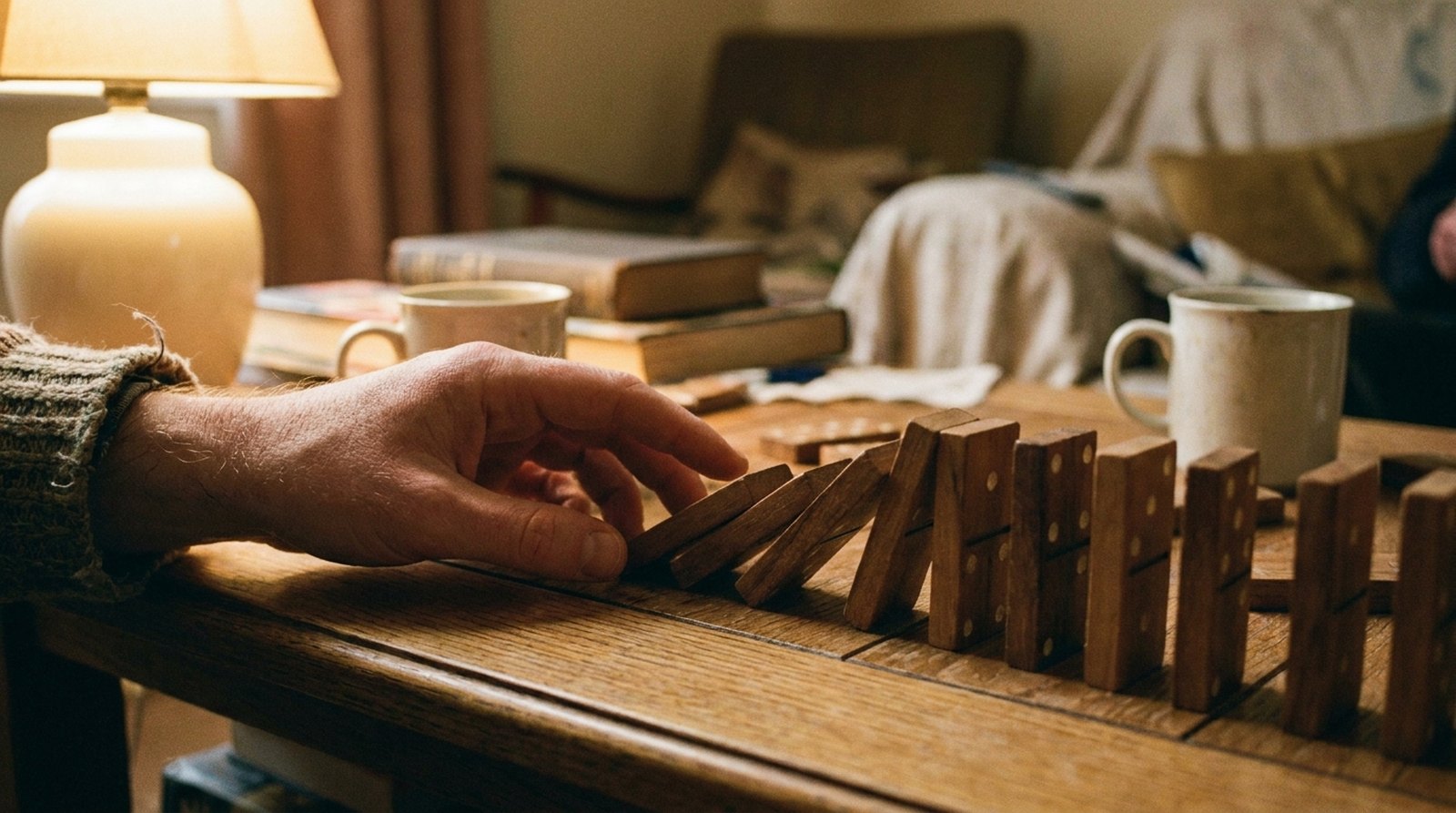
To be honest, I've got plenty of ways I could wrap this up well — a clean line, something that lands. But even reaching for one, there's a small dread sitting underneath it.
What if that's already decided too?